From Shadows to Solutions: Tackling Poverty by Starting with Elders
Updated: Feb 4
By Cathy Li
Yew Chung International School (Hong Kong Campus)
The Global Issue Discussed
"Most of us are currently being educated in schools, living in warm and secure homes, and enjoying more than three meals a day. But have you ever considered how those at the other end of the wealth spectrum live?" We are suffering from profound inequality and unequal distribution of incomes globally, which, supported by the World Bank, shows that 24% of people globally live in poverty, while 8.5% of people live in extreme poverty, earning $2.15 every day. This is around 17 HKD! Even a cheap bowl of noodles from a small food stall costs more than 20 HKD, so how do these people even survive?
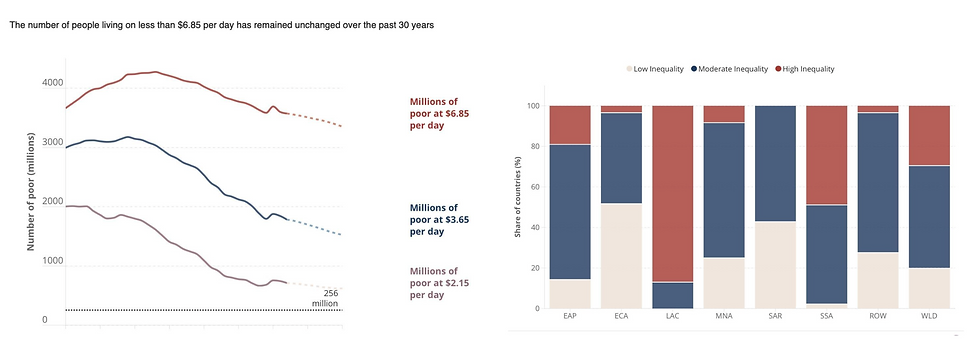
The answer is, they hardly do. This situation is exacerbated in Hong Kong, where only 25% is urbanised, while the rest consists of rural areas filled with villages, farmland, and islands. This is mostly because Hong Kong was a sparsely populated area of farming and fishing villages that is yet to be developed today, while Hong Kong’s urban spaces are highly developed. Hong Kong’s economy is also extremely imbalanced, since on one hand, it is one of the major financial hubs in the world, while on the other, many disadvantaged people are suffering day by day because of Hong Kong’s relatively high prices. You might have heard this phrase before, “The rich grow richer and the poor go poorer.” Unfortunately, in this society, this phrase is rarely seen wrong. A poor family will likely have a poorer next generation, while a rich family will likely have a richer generation.
This is easier to explain if we talk about the expenses for the lower-paid family. Even if they don’t have children, they will need to afford all their necessities, like food, water, shelter, and arguably education too. But it becomes a problem when they generally only have an income of <40 HKD per day for a person (if they can even get a job in the first place). Food would likely already cost all the income already if the family only eats one meal a day with the cheapest non-nutritious food. This leaves them no money for shelter, as some may only sleep on their trusty cardboard that they scavenged next to the trash bin.
In relation to this, regarding citizens of Hong Kong that have lived or been in slightly older and developing areas like Shum Shui Po, you probably have seen old grandmas pulling trolleys of cardboard with their crooked backs. They are most commonly known as cardboard grannies. These grannies also bring light to another issue, elderly poverty. “The city now having the longest life expectancy in the world, Hong Kong is struggling to support its rapidly ageing population.” Says The Guardian. Hong Kong has one of the highest life expectancy in the world, and it might sound good, but these elderly people struggle to get a job and most are struggling beneath the poverty line. One of the reasons for this is that “Many elderly in the city don’t have any type of pension scheme because they were working class, low-income workers” says Ng Wai-tung from the Society for Community Organization. Hong Kong’s pension system mostly relies on the Mandatory Provident Fund (MPF) scheme, which is only focused on retiring elderly people that have accumulated enough savings. Therefore, this leaves the rest resorting to scavenging for cardboards and selling them to earn money, as they are declined from job applications and left with no other options to support their family.


One example of a local grandma was a 65 year old grandma called Miss Wong written by The Guardian. She usually spends from 7am to 9pm searching for disused cardboard, in which she only earns around 41HKD for her efforts. Miss Wong also says that “Even a subdivided flat costs around HK$4,000 per month ,and I didn’t have the money for that.” Which led her to become homeless.
These actions are often the result of inequality and flaws in government law, but relying on cardboard as the only source of income can also have drastic effects on these elderly individuals. One of the ‘Cardboard Granny’ Lan Tsz says, “The environmental and food hygiene department comes and confiscates my cardboard twice a week, they even try to resell it themselves.” Government workers regularly survey the streets and confiscate these cardboard that the grannies depend on, under the existing law of obstructing public space or unlicensed hawking. Another publicised case in 2017 further revealed the severity of the issue. As HKFP (Hong Kong Free Press) writes about the situation. An elderly Hong Kong woman has faced a potential fine of up to HK$5,000 and prison time after she was charged by the government for selling a piece of cardboard for HK$1 without a licence.
For defence, the Civic Party district councillor Lai Chi-keong posted a mitigation letter he wrote to the court on Wednesday night, “75-year-old Mrs Chu suffers from various ailments, these include: the ‘three highs’ [blood pressure, blood sugar, cholesterol], arthritis causing her fingers to bend, nasal inflammation and stomach sickness.” Mrs Chu is now spending her days fearful of the penalty as well as her confiscated hand-pulled cart, which she also says was borrowed from someone else. Her future is now potentially in the hands of the lawyer in this case, as they are waiting for a final verdict.
These case studies all point to the flaws that the Hong Kong government may have. And as we might not be able to change the law itself, we can start by helping the majority of the population that are under the poverty line, the elderly. This is where our service group from Yew Chung International School comes in. Our service group is called “Help the poverty, help the poor elderly.” And even though we are only a group that is currently in establishment and is not a real group for now, our motivations have driven us together. Our goal is to, as the name suggests, help the poor elderly who are on the streets of Hong Kong. We are targeting those who are 65 or above, as they are the range of elderly people roaming the streets homeless, and are also the age generally considered elderly in HK.
The Initiative
We strive to help with the main issue of poverty in Hong Kong by listening to the problems of elders and coming up with solutions. We currently have many actions planned, in which most of which are interviews in more rural areas, where we can take note of the problems that the elderly are undergoing, and help them to the best of our abilities. This could be the smallest things like bandages/protection gadgets for their fingers, or even a more advanced cart where the handles can extend to suit the height of the elder and can minimize the harm on their back. This can be designed by our talented designers in our group and given to the elders in need.
Not only that, even if most pension schemes currently benefit retired elderly with enough money, the government also provides many services for the older population. This includes the Elderly Healthcare Voucher Scheme, Public Healthcare Services, Elderly Dental Care services, Community Health Services, and Elderly Vaccination Programs at certain periods of time. Unfortunately, most elderly people do not know of these services or regard these services as “too complicated to register.” There are also many who do not know how to read and thus miss out on many opportunities for free healthcare. This is why we also strive to help these elderly people experience these services and take the most out of government benefits with our huge variety of research resources. In the future, we are also planning on registering these elders in nursing homes that are operated by non-profit organizations that focus more on social contribution rather than profit. Of course, we might meet elders that we may have difficulty communicating with, in which we can work together as a group to interpret what they are trying to say and also use technology. We can also face problems like the elderly do not match the requirements of the services, then we could either send an email first to clarify, or help find another similar service.


Comments